

Winged Carpenter Ants Indoors in Spring: What Swarmers Actually Mean
A dozen large winged ants clustered at a sunny window in April is one of the most consequential pest signs an Overland Park homeowner can find, and one of the most commonly dismissed. People vacuum them up, note that they seem to have come from nowhere, and move on. What those swarmers are telling you deserves a much more serious response.
What a Swarmer Is
Swarmers — properly called alates — are the winged reproductive males and females a colony produces to fly off, mate, and found new colonies elsewhere. They are not workers and they are not a different species. They are the colony's reproductive output.
Here is the critical part: a colony does not produce swarmers until it is mature. Carpenter ant colonies typically need several years of growth before they divert resources into reproductives. Swarmers are, in effect, a colony announcing that it has been established long enough and grown large enough to reproduce.
Why Indoors Changes Everything
Finding a few winged ants outdoors in spring is normal. Carpenter ants live in the woods, in stumps, and in dead trees all over Johnson County, and swarms happen every year.
Finding them inside your house is different. Swarmers are drawn to light and immediately head for windows and doors after emerging. If they are emerging on the interior side of your windows, they did not fly in from the yard — they came out of the structure. Combined with the fact that swarmers indicate a mature colony, the conclusion is direct: there is an established carpenter ant nest inside your home, and it has been there for years.
That is the entire significance of the sign. Not that ants got in, but that a colony has been quietly excavating wood in your walls long enough to reach reproductive maturity.
Confirming They Are Carpenter Ants
Before acting, make sure of what you have — termite swarmers appear in the same season and are frequently confused:
- Waist: carpenter ants have a sharply pinched waist. Termites have a straight, uniform body with no pinch.
- Antennae: ant antennae are elbowed and bend at a joint. Termite antennae are straight and beaded.
- Wings: ant forewings are noticeably longer than the hindwings. Termite wings are all equal length and much longer than the body, and they shed easily, leaving piles of identical wings on sills.
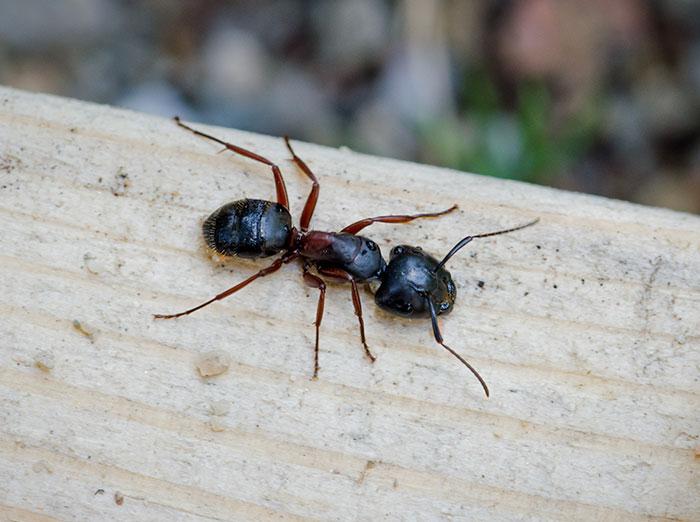
- Size and color: carpenter ant swarmers are large — often half an inch or more with wings — and dark, usually black or black with reddish coloring.
Save a few specimens in a sealed bag or take a clear close-up photo. Both insects are serious, but they require entirely different treatment, so identification comes first. Our full comparison of carpenter ants and termites covers the distinctions in more depth.
When It Happens in Overland Park
Carpenter ant swarming typically runs from early spring into early summer, often triggered by warming temperatures and humidity. Indoor swarms frequently happen earlier than outdoor ones, because a colony inside a heated wall experiences spring before the outdoors does. That is why a homeowner may find winged ants at a window in late winter or very early spring while there is nothing happening in the yard — another indication the nest is inside.
What to Look for Next
Once you have swarmers, go looking for the nest evidence. Start where the swarmers appeared and work outward:
- Frass. Small piles of sawdust-like material mixed with insect parts beneath window frames, baseboards, door frames, sill plates, or ceiling edges. This is the strongest indicator of an active gallery above or behind it.
- Sound. Faint rustling or crackling inside walls, most audible at night when the colony is active and the house is quiet.
- Damaged wood. Tap suspect areas and listen for hollowness. Carpenter ant galleries are smooth and clean inside, with no mud packed in them.
- Foraging workers. Large black ants trailing along baseboards, plumbing lines, or the tops of walls, especially after dark.
- Moisture. Look hard for the water source — leaking roof or gutters, chimney flashing, plumbing leaks, condensation, weather-exposed window and door frames, deck posts in soil contact, a damp crawl space. Carpenter ants strongly prefer wood softened by moisture, so the nest and the leak are usually in the same place.
What Not to Do
Do not simply spray or vacuum the swarmers and consider it handled. Swarmers die quickly indoors on their own — they cannot found a colony inside a house, and killing them has no effect whatsoever on the nest that produced them. All you accomplish is removing the evidence, which is how these problems continue undetected for another few years.
Do not spray the foraging workers either. Surface treatment kills the ants you can see while the colony, including satellite nests elsewhere in the structure, continues excavating. It can also make the colony harder to locate later.
Winged ants indoors mean a mature nest in your walls. Our carpenter ant service locates the nest and its satellites, treats the colony directly, and finds the moisture feeding it.
Explore Carpenter Ant ExterminationWhat Actually Needs to Happen
Effective carpenter ant control after an indoor swarm involves three things. First, locating the nest and its satellites — carpenter ants commonly maintain a parent colony and multiple satellite nests, so finding one is not finishing. Second, treating the colony directly with methods that reach into galleries and voids rather than coating surfaces. Third, correcting the moisture that made the wood attractive, because a repaired leak is what keeps the next colony from moving into the same softened wood.
It is also worth having the affected wood evaluated. A colony mature enough to swarm has been excavating for years, and depending on where it settled — sill plates, joists, framing, window and door frames, decking — there may be damage to assess alongside the pest work.
If you have found winged ants inside your Overland Park home this spring, treat it as a call-now situation. Frontier Trapper will identify the species, locate the nest and satellites, treat the colony, and find the moisture source behind it.