

German vs. American vs. Oriental Cockroaches: Which One Is in Your Overland Park Home?
Finding a cockroach is unsettling enough that most people do not stop to examine it. But which species you have changes almost everything about what happens next — whether the roaches are breeding inside your kitchen or wandering up from a drain, whether you are facing a two-week problem or a two-month one, and where the treatment actually needs to go. Three species account for nearly every cockroach call in Overland Park.
German Cockroach: The One You Don't Want
Small — about half an inch to five-eighths — light tan to brown, with two dark parallel stripes running lengthwise behind the head. That striped marking is the identifier.
German cockroaches are the species that genuinely infests. They live indoors exclusively, breed year-round, and reproduce faster than any other roach in the region — a single egg case holds up to 40 eggs, and a female produces several in her lifetime. They stay close to food and warmth, which means kitchens and bathrooms: behind and under refrigerators and dishwashers, inside cabinet voids, around motor housings on appliances, under sinks, and in the seams of small appliances like microwaves and coffee makers.
What it means: German cockroaches indoors mean an established breeding population, not a wanderer. Their small size lets them hide in places surface spraying will never reach, and their reproductive rate means a handful becomes a serious problem in weeks. This species is also the one most strongly associated with asthma and allergy symptoms, because the population density indoors builds up allergen levels in dust.
American Cockroach: The Big One From the Sewer
Large — often an inch and a half or more, the biggest roach most people ever see indoors — reddish-brown, with a pale yellowish figure-eight or halo pattern on the shield behind the head. Adults have full wings and can glide, which is how a "flying cockroach" story starts.
American cockroaches prefer warm, damp, dark places and are strongly associated with sewers, storm drains, steam tunnels, and basements. In Overland Park homes they typically turn up in basements, floor drains, crawl spaces, utility rooms, and around water heaters. Heavy rain that floods storm drains often pushes them up into homes, which is why sightings cluster after storms.
What it means: usually an entry problem rather than a kitchen infestation. Look at drains, sewer line access, sump pits, foundation cracks, and utility penetrations. They do breed indoors given enough warmth and moisture, but their population growth is far slower than German cockroaches.
Oriental Cockroach: The Damp Basement Roach
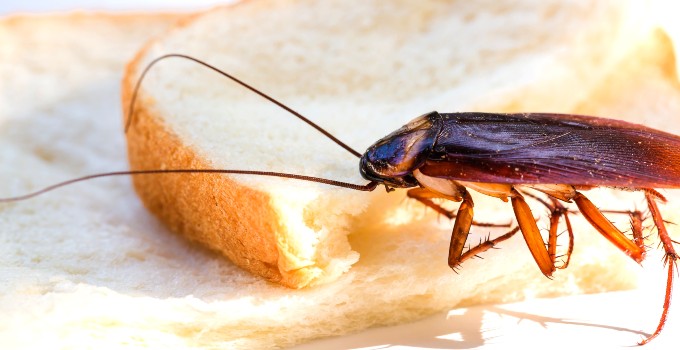
Roughly an inch, very dark — nearly black — and glossy, with a distinctly smooth, oily-looking sheen. Females are broad and essentially wingless; males have short wings that do not cover the abdomen. Neither flies.
Often called "water bugs," Oriental cockroaches are the most moisture-dependent of the three and the slowest moving. They live in cool, damp places: basements, crawl spaces, floor drains, sump pits, window wells, beneath porches and stoops, and in leaf litter and mulch against the foundation. They come indoors from outside, especially in late spring and summer, and during dry stretches when they follow moisture inward.
What it means: a moisture and drainage problem. Oriental cockroaches in a basement point to standing water, poor grading, a wet crawl space, or drains that stay damp. They also produce a noticeably musty odor when populations build.
The Quick Comparison
- Small, tan, two dark stripes behind the head, in the kitchen: German cockroach. Established indoor breeding population — the most serious of the three.
- Very large, reddish-brown, halo pattern on the shield, in the basement after a storm: American cockroach. Usually coming in from drains and sewers.
- About an inch, glossy near-black, slow, in a damp basement or window well: Oriental cockroach. A moisture and drainage issue.
- Seen in daylight, out in the open: a bad sign with any species. Cockroaches are nocturnal, and daytime activity usually means the harborage areas are overcrowded.
Identified the species? The next step is species-specific treatment that reaches the harborage over-the-counter products can't. See how our cockroach extermination service does it.
Explore Cockroach Extermination in Overland ParkWhy the Species Changes the Treatment
A German cockroach problem is solved indoors, through careful placement of gel baits and targeted treatment of harborage voids — inside cabinets, behind appliances, around motor housings — combined with intensive sanitation. Broad interior spraying actively hurts here, because it repels roaches away from the baits and scatters them into new voids.
An American cockroach problem is solved largely at the perimeter and the plumbing: sealing drain access and sewer penetrations, correcting basement moisture, and treating exterior harborage. An Oriental cockroach problem is solved by drying things out — fixing drainage and grading, extending downspouts, dehumidifying the crawl space or basement, clearing leaf litter and mulch from the foundation — plus an exterior barrier.
Treat all three the same way and you will get poor results on at least two of them.
Signs Worth Checking For
- Droppings: German cockroach droppings look like coarse black pepper or coffee grounds; American and Oriental droppings are larger, blunt-ended cylinders.
- Egg cases (oothecae): small brown purse-shaped capsules in cabinet corners, behind appliances, or in cracks.
- Smear marks: dark, irregular streaks along walls and surfaces in damp areas where roaches travel.
- A musty, oily odor: strongest with Oriental cockroaches and with any large population.
- Shed skins: pale cast skins near harborage sites, indicating active growth.
What to Do
Try to get a photo of the roach before treating anything — identification drives everything else. If it is small with two stripes, act quickly and avoid over-the-counter foggers, which scatter German cockroaches deeper into the structure and make professional treatment harder. If it is large and turning up in the basement, start looking at drains, moisture, and foundation penetrations.
Frontier Trapper identifies the species first, then builds the treatment around it — baiting and harborage work for German cockroaches, drain and perimeter exclusion for American cockroaches, moisture correction for Oriental cockroaches. For more on catching a problem early, see our guide to the early signs of a cockroach infestation, and for keeping them out, our cockroach prevention tips.