

Camel Crickets vs. House Crickets vs. Field Crickets: Which One Is in Your Home?
Three crickets account for nearly every cricket call we get in Overland Park, and telling them apart is more useful than it sounds. Each one points to a different underlying cause — indoor warmth, the fall migration and your outdoor lighting, or basement moisture — and that determines whether the fix is mainly exterior, interior, or moisture-focused. Identify the cricket and you have most of the answer.
House Crickets
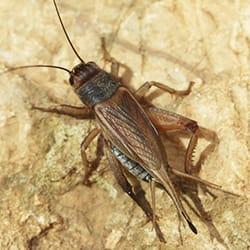
Light yellowish-brown, about ¾ to ⅞ inch long, with three dark bands across the head and long wings laid flat over the back. These are the classic chirpers — males rub their wings together to attract females, and that is the sound people hear at night.
House crickets are the species most willing to live indoors year-round. They tolerate the warm, dry conditions inside a house, feed on almost anything organic, and will breed in a basement, garage, or utility area. Chirping coming from inside a wall usually means house crickets, and it usually means they are established rather than passing through.
What it points to: an interior population. Sealing alone won't solve it — the crickets are already in.
Field Crickets
Larger and dark brown to black, up to about an inch, with a stout body and long wings. Field crickets look like the cricket most people picture, only bigger and darker than a house cricket.
They live outdoors and don't generally establish inside, but they swarm toward buildings in late summer and fall — especially around exterior lights. As Midwest crops are harvested, field cricket habitat is destroyed and huge numbers of displaced crickets move toward nearby homes and neighborhoods. They pile up around porches, garages, and doorways, and enough of them find a gap that homeowners start seeing them indoors. Indoors they typically die within a couple of weeks.
What it points to: an exterior migration problem driven by lighting and unsealed gaps. Timing the perimeter treatment before the fall wave is what works.
Camel Crickets (Cave or "Spider" Crickets)
Pale tan and often mottled, distinctly humpbacked, completely wingless, with long spider-like legs and long antennae — roughly the size of a large spider, which is exactly what people usually think they are seeing at first.
Camel crickets are the ones that unnerve people most. They are wingless, so they cannot chirp at all — a silent cricket is a camel cricket. Instead of fleeing, they jump toward whatever startles them, which is a defensive reflex and the reason a basement light switch can send half a dozen of them launching in your direction. They need damp, dark conditions and thrive in basements, crawl spaces, garages, and window wells.
What it points to: moisture. Camel crickets in numbers mean a damp basement or crawl space, and the moisture keeps the population going long after fall ends.
The Quick Comparison
- Chirping at night, indoors: house crickets. Only winged males chirp, and only house crickets reliably live indoors.
- Big black crickets swarming the porch in September: field crickets, riding the fall migration in from harvested fields.
- Silent, humpbacked, wingless, jumping at you in the basement: camel crickets, and you have a moisture problem.
- Long spider-like legs and no wings: camel cricket, every time. Both house and field crickets have obvious wings.
Why Overland Park Homes Get All Three
Johnson County offers each species what it needs. The surrounding agricultural land drives a heavy fall field cricket migration into neighborhoods every year. Bright exterior lighting on porches, garages, and landscaping acts as a beacon for both field and house crickets. And the basements, walkout lower levels, and crawl spaces common in area homes are prone to summer humidity, poor drainage, and water intrusion — ideal camel cricket habitat that sustains populations year-round.
How Crickets Get In
All three enter at ground level, guided by light and warmth:
- Gaps under exterior and garage doors without tight sweeps.
- Foundation cracks and expansion joints where a patio or driveway meets the house.
- Crawl space vents, basement window wells, and low utility penetrations.
- Torn screens and gaps around doors and windows left open on warm evenings.
Not sure which cricket you're dealing with? We'll identify the species and treat inside and out. See how our cricket control service handles all three.
Explore Cricket Removal in Overland ParkWhat This Means for Getting Rid of Them
Because field and house crickets are pulled in by light and camel crickets by moisture, the most effective control pairs sealing entry points with reducing the attractant behind the specific species you have. Field crickets call for a well-timed exterior perimeter barrier ahead of the late-summer and fall migration, plus lighting changes — switching exterior bulbs to yellow "bug" lights or warmer LEDs and keeping unnecessary lights off. Camel crickets call for moisture correction in the basement or crawl space along with targeted interior treatment of harborage zones. House crickets in a wall need interior work to clear the established population.
A few crickets in the fall is normal here. Persistent chirping, repeated basement sightings, or chew damage on fabric and paper signal an established population that won't clear on its own. Frontier Trapper identifies the species first, then treats inside and out and seals and adjusts the home so crickets stop finding their way in.