
Otter, Beaver, or Muskrat? Telling Apart the Animals in Your Pond
Something is living in or visiting your pond, and it matters a great deal which of the three it is. Around Overland Park, a semi-aquatic animal at the water's edge is almost always a river otter, a beaver, or a muskrat — and they could hardly be more different. One eats your fish, one fells your trees and floods your land, and one burrows into your banks. Identifying which you have tells you what damage to expect and what to do about it.
The Fastest Tell: The Tail
If you get a clear look at the tail, the question is usually answered:
- Otter: a long, thick, muscular tail that tapers smoothly to a point — roughly a third of the animal's length.
- Beaver: a wide, flat, scaly paddle, held horizontally and unmistakable.
- Muskrat: a thin, mostly hairless tail flattened side-to-side (vertically), which it sculls with as it swims.
Compare the Size and Body
The three differ sharply in size and shape:
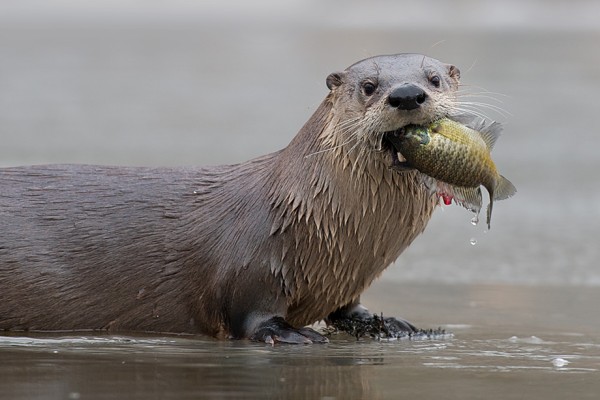
- Otter: 3 to 4 feet long including the tail, 10 to 30 pounds, with a sleek, streamlined, tube-shaped body built for fast swimming.
- Beaver: the largest of the three at 35 to 65 pounds, with a bulky, rounded body and a broad head.
- Muskrat: the smallest, about the size of a small rabbit at 1.5 to 4 pounds, looking like a large rat that swims.
The Difference That Matters Most: Diet
This is where identification turns into a plan, because what each animal eats is what it damages:
- Otter: a carnivore that eats fish, crayfish, frogs, and other aquatic prey. An otter is the one emptying a stocked pond of fish.
- Beaver: a herbivore that eats bark, twigs, leaves, and aquatic plants, and fells trees for food and building. A beaver is the one gnawing down your trees and damming water.
- Muskrat: a herbivore that eats cattails, rushes, and other aquatic vegetation. A muskrat is the one burrowing dens into your banks and thinning shoreline plants.
Read the Sign They Leave Behind
You will often find evidence before you ever see the animal, and each leaves a distinct signature:
- Otter sign: partially eaten fish and scattered scales on the bank, communal "latrine" sites piled with dark, fishy-smelling scat full of scales and crayfish parts, and worn slides into the water.
- Beaver sign: cone-shaped or pencil-pointed tree stumps, debarked trunks, wood chips, stick-and-mud dams across water, and domed stick lodges.
- Muskrat sign: burrow openings in the bank at or below the waterline, thinning cattails and shoreline plants, and small dome-shaped lodges built of vegetation.
The Quick Comparison
- Fish disappearing, fish carcasses and latrine sites on the bank: otter.
- Trees felled, water dammed and rising, stick lodges: beaver.
- Bank burrows, thinning cattails, small vegetation lodges: muskrat.
- Tapered pointed tail: otter. Flat paddle tail: beaver. Thin side-flattened tail: muskrat.
- Sleek and fast in the water: otter. Bulky and broad: beaver. Small and rat-like: muskrat.
Fish vanishing and finding carcasses on the bank? That points to a river otter, and they can clear a stocked pond fast. We remove them legally and protect your water.
Explore Otter Removal in Overland ParkWhy It Changes What You Do
Each animal is a different problem with a different solution. An otter is a fish-predation problem solved by legal trapping within Kansas's regulated furbearer season plus pond protection. A beaver is a flooding-and-tree problem solved by trapping paired with dam and water management. A muskrat is a bank-integrity problem solved by trapping plus bank repair and habitat change. Misidentify the animal and you aim the wrong solution at the wrong damage.
For a closer look at the two herbivores specifically, our guide on telling muskrats and beavers apart goes deeper, and our beaver and muskrat service pages cover how each is resolved.
What to Do Once You Know
All three are wildlife governed by Kansas regulations, and none should be handled by hand — they can bite defensively and carry parasites and disease. If fish are vanishing and you are finding carcasses and latrines, you likely have an otter, and because otters travel connected waterways and hunt in family groups, a stocked pond can be thinned quickly. Whichever animal you have, an on-site assessment confirms the species and the sign, and Frontier Trapper resolves it legally and humanely — removing the animal and protecting the pond or banks so the problem does not simply repeat.